This final entry on the fruits of the spirit concerns love. I saved love for last because of its power. I believe it encompasses all of the other fruits.
The love that I will discuss as a fruit of the spirit is agape (ἀγάπη) love, which is the truest form of love. It is unconditional love through choice and not by happenstance. It is unconquerable goodwill. Agape love differs from other forms of love that people express. These forms that will not be discussed are philia (φιλία) love, or loyalty to friends; eros (ἔρως) love, or romantic/passionate longing; and storge (στοργή) love, or the natural affection like that a parent feels for a child.
The Class of 2009’s motto for the Zambia build was “Built with Love”. When we reached Zambia, our goal was to work in the spirit of love. If we were to claim a conquest at the end of our journey, it would be to have spread agape love to all whom we have touched, and to receive it back.
We were never alone in mixing cement, digging out a foundation, laying bricks, or shoveling backfill. We were part of a diverse, international team that included the future homeowners themselves. We had our foremen, additional contractors, our Habitat coordinators, future neighbors of the homeowners, fellow villagers, and ourselves. All of these team members realized the truth of what a home built with love could do in a family’s life. They rejoiced at the opportunity to be a part of it, and to let this truth continue to prevail.
There are three different models of service: doing for, doing with, and being with. The first one implies subjugation and does not emphasize the relationships built. The second one acknowledges cooperation, but it puts a heavier focus on the tasks rather than the relationships. The third model reflects an emphasis on relationships, on service that is not self-seeking. It does not take into account the titles, status, or backgrounds of the participants. It is the true spirit of goodwill; it is love.
In serving our Periclean partners, we are a part of a community that gives and takes equally. For every act of service we give to our partners, they give us a feeling, a token, a word of thanks in return. For every photo we take, for each memory and story we take, our partners take hugs, memories, and more. My only reason for mentioning this is because this dynamic is hidden and not considered. We do not keep score. Our partners give more to us than we could ever imagine, and vice versa. We do not do favors for one another; we are of service to one another. I believe that this dynamic, and the lack of scorekeeping, grows agape love in the Periclean spirit. This is unconquerable goodwill.
During the closing ceremonies, it was said that our greatest failure would be if we did not return to Kawama to grow the community and build more houses, in the same spirit as when we first arrived. We certainly took this to heart and laid the foundation for future groups to come. In May-June 2011, we showed our obedience to our word by sending a second Elon team to complete a build. Our class, and the program as a whole, consistently lives up to the expectation of sustained partnerships. This loyalty is a measure of love, as agape love never ends.
Lontia’s and Rosemary’s homes were built with love. The Periclean program grows the spirit of love through the nature of its service. As a result of the Periclean opportunity to serve, the fruit of love has grown immeasurably in the hearts of Elon’s Periclean Scholars and those they touch. To end this series, I shall continue in the spirit of thanks, to acknowledge the impact of the Periclean program on growing the fruits of the spirit in me - all of them being encompassed by love. Thank you for assisting me on the journey toward obedience to virtue.
Showing posts with label fruits of the spirit. Show all posts
Showing posts with label fruits of the spirit. Show all posts
Friday, August 26, 2011

Wednesday, August 17, 2011
Self-Control - Periclean Scholars & Fruits of the Spirit Series
Today’s fruit of the spirit is self-control. I will treat self-control as having possession over one’s own behavior, as well as resisting the urge to give in to temptation.
I will begin with an anecdote from Zambia. Proverbs 25:28 states, “Like a city whose walls are broken down is a man who lacks self-control.” In this regard, I believe that self-control was cultivated while constructing our Habitat homes in Zambia. One of our main goals in building the houses was to ensure that they were structurally sound. As amateur builders, we relied heavily on our foreman, Noah, for guidance. Sometimes, I was tempted to stack bricks, smooth cement, and stack more bricks at a rate faster than recommended by Noah. This was only compounded by the frequency of downpours during the rainy season, so building time was precious. However, the Periclean program taught us the importance of listening to our partners in all things - especially when they are the clear experts on the matter. Listening to our partners’ needs meant resisting the urge to move too rapidly and delaying the gratification of completing the house. By modifying our behavior and not giving into temptation, we slowly but surely constructed strong homes that will last for generations.
I have often been told that I am very disciplined in nature, as evidenced through my success in marathon training runs done mostly by myself before the sun rises. I control my own behavior by getting in my miles and resist temptation by not sleeping in late.
Lately, however, I feel that living out the virtue of self-control - as well as many other virtues - has become a particular challenge to fully live out. A couple of events in my life have caused my balance to be thrown off kilter; even though it only marginally affects my running, in other areas I haven’t felt like myself for the past couple of days. Yet, I believe that it is in the toughest moments that we show our greatest strengths. I have been pulling from my Periclean toolbox to help me live up to these challenges.
My most recent challenge has been to not lash out at others who have hurt me or to seek vengeance against them. I have been seeking out ways to re-channel this negative energy and exert self-control by not giving in to such a damaging temptation. These vindictive feelings are not characteristic of my nature, so I have been trying to get rid of them as quickly and definitively as possible. I do not want any walls in my city to be knocked down as a result of bad blood.
Yesterday, I found that the best way to restore my balanced nature was in a manner that is completely Periclean: losing myself in service to others. I had one of my regular shifts at the safehouse. Now, sometimes it depends; I can leave feeling awful, because it is a stressful night and clients do not treat me like royalty (and that’s expected as part of the work). However, last night was the most exhilarating. I had my first intake. What that means is I facilitated a new client’s transportation to the safehouse, got the person oriented, helped to calm them down, and made them feel at home - like they did the right thing. My time was not spent lamenting my situation. I delayed (and partially erased) my selfish, negative feelings and my desire for vengeance by directly helping someone to flee domestic violence. By losing myself in service, I worked to find my balance.
Service, whether it be in the local community or around the globe, is an excellent avenue to grow the fruit of self-control. Servants resist the temptation to claim all of their time on earth as their own, and they give it freely to those in need. They listen to the needs of others and do not judge before getting complete information. They resist the temptation to condemn, and they choose love. In working with the Periclean partners, I found my colleagues and mentors exemplified this spirit of self-control. While it is not the sexiest of the fruits, I find its fruit to be one of the most sweet in the end.
I am thankful for the Periclean program for showing me the value of self-control, and providing me with the toolkit to value service as a means to achieve this fruit.
I will begin with an anecdote from Zambia. Proverbs 25:28 states, “Like a city whose walls are broken down is a man who lacks self-control.” In this regard, I believe that self-control was cultivated while constructing our Habitat homes in Zambia. One of our main goals in building the houses was to ensure that they were structurally sound. As amateur builders, we relied heavily on our foreman, Noah, for guidance. Sometimes, I was tempted to stack bricks, smooth cement, and stack more bricks at a rate faster than recommended by Noah. This was only compounded by the frequency of downpours during the rainy season, so building time was precious. However, the Periclean program taught us the importance of listening to our partners in all things - especially when they are the clear experts on the matter. Listening to our partners’ needs meant resisting the urge to move too rapidly and delaying the gratification of completing the house. By modifying our behavior and not giving into temptation, we slowly but surely constructed strong homes that will last for generations.
I have often been told that I am very disciplined in nature, as evidenced through my success in marathon training runs done mostly by myself before the sun rises. I control my own behavior by getting in my miles and resist temptation by not sleeping in late.
Lately, however, I feel that living out the virtue of self-control - as well as many other virtues - has become a particular challenge to fully live out. A couple of events in my life have caused my balance to be thrown off kilter; even though it only marginally affects my running, in other areas I haven’t felt like myself for the past couple of days. Yet, I believe that it is in the toughest moments that we show our greatest strengths. I have been pulling from my Periclean toolbox to help me live up to these challenges.
My most recent challenge has been to not lash out at others who have hurt me or to seek vengeance against them. I have been seeking out ways to re-channel this negative energy and exert self-control by not giving in to such a damaging temptation. These vindictive feelings are not characteristic of my nature, so I have been trying to get rid of them as quickly and definitively as possible. I do not want any walls in my city to be knocked down as a result of bad blood.
Yesterday, I found that the best way to restore my balanced nature was in a manner that is completely Periclean: losing myself in service to others. I had one of my regular shifts at the safehouse. Now, sometimes it depends; I can leave feeling awful, because it is a stressful night and clients do not treat me like royalty (and that’s expected as part of the work). However, last night was the most exhilarating. I had my first intake. What that means is I facilitated a new client’s transportation to the safehouse, got the person oriented, helped to calm them down, and made them feel at home - like they did the right thing. My time was not spent lamenting my situation. I delayed (and partially erased) my selfish, negative feelings and my desire for vengeance by directly helping someone to flee domestic violence. By losing myself in service, I worked to find my balance.
Service, whether it be in the local community or around the globe, is an excellent avenue to grow the fruit of self-control. Servants resist the temptation to claim all of their time on earth as their own, and they give it freely to those in need. They listen to the needs of others and do not judge before getting complete information. They resist the temptation to condemn, and they choose love. In working with the Periclean partners, I found my colleagues and mentors exemplified this spirit of self-control. While it is not the sexiest of the fruits, I find its fruit to be one of the most sweet in the end.
I am thankful for the Periclean program for showing me the value of self-control, and providing me with the toolkit to value service as a means to achieve this fruit.
Sunday, August 14, 2011
Gentleness - Periclean Scholars & Fruits of the Spirit Series
What do you desire? Shall I come to you with a rod, or with love and a spirit of gentleness? 1 CORINTHIANS 4:21
Today’s fruit of the spirit is gentleness. It relates to kindness in many ways but is its own fundamental virtue. I see gentleness as having strength with an even temper and tranquil spirit. This challenges most people’s idea of the source of strength and how to grow it, but the fruit of gentleness arises when someone is strong in the truest sense of the word.
What does it mean to be a “strong” person? In American society, we often associate strength with muscular ability, the number of drinks we can stomach, the amount of willpower we have, or courage to stand up to the bad guy. All of these things constitute strength in the most superficial sense. They are right, but they should not be the first thing that comes to mind.
I believe that strength comes from the acknowledgement of weakness, the internalization of another’s struggle, or the holding off of judgement. In many respects, this is the opposite of society’s view of strength. True strength is not hitting your wife; it’s listening to her. True strength is holding off on those drinks and taking watch over friends. True strength, in many cases, is not attacking the bad guy but showing him the path to virtue.
Strong relationships are woven with gentleness. The approach to international relations taken by the Periclean Scholars program is to select meaningful partnerships and then to spend time listening to them and getting to know their needs. The goal is not to impose American will on these communities, but rather to unpeel the layers of the societies’ greatest needs. We do not make war or shove our theories down their throats. We hold back the rods and guns and encourage the hugs and open ears.
The Periclean program grows gentleness first through the classroom setting. We read and write about our partner communities in the academic setting and synthesize all of the elements that have created certain outcomes. The second way that the Periclean program does this is through the community setting. We listen to the Elon and greater community’s perspectives on why issues are a certain way and then educate them about the layers that construct these issues. We show no anger toward others, accepting that they obtained their perspectives from as complete information as they had at the time. We believe that increased community knowledge increases compassion, especially on the international development front. The third way that we build gentleness is through our ground work. Interacting with our partners helps us to build an even more complete picture of why things are the way that they are. The layers are unpeeled, and we show true strength and gentleness in learning and simply accepting our partners’ lots in life as different and not inferior.
All aspects of the Periclean program have helped to make me a stronger and more gentle person. Granted, this is a fruit that I have not yet perfected - as I have not perfected any of them, in my opinion - but my heart is in the right place and I am on the right track because of the Periclean influence. I use more of my time and resources to ease someone’s burden, to set them free, and to use my inner strength for the benefit of others. This benefit becomes mutual, as the fruit of gentleness grows strong.
Today’s fruit of the spirit is gentleness. It relates to kindness in many ways but is its own fundamental virtue. I see gentleness as having strength with an even temper and tranquil spirit. This challenges most people’s idea of the source of strength and how to grow it, but the fruit of gentleness arises when someone is strong in the truest sense of the word.
What does it mean to be a “strong” person? In American society, we often associate strength with muscular ability, the number of drinks we can stomach, the amount of willpower we have, or courage to stand up to the bad guy. All of these things constitute strength in the most superficial sense. They are right, but they should not be the first thing that comes to mind.
I believe that strength comes from the acknowledgement of weakness, the internalization of another’s struggle, or the holding off of judgement. In many respects, this is the opposite of society’s view of strength. True strength is not hitting your wife; it’s listening to her. True strength is holding off on those drinks and taking watch over friends. True strength, in many cases, is not attacking the bad guy but showing him the path to virtue.
Strong relationships are woven with gentleness. The approach to international relations taken by the Periclean Scholars program is to select meaningful partnerships and then to spend time listening to them and getting to know their needs. The goal is not to impose American will on these communities, but rather to unpeel the layers of the societies’ greatest needs. We do not make war or shove our theories down their throats. We hold back the rods and guns and encourage the hugs and open ears.
The Periclean program grows gentleness first through the classroom setting. We read and write about our partner communities in the academic setting and synthesize all of the elements that have created certain outcomes. The second way that the Periclean program does this is through the community setting. We listen to the Elon and greater community’s perspectives on why issues are a certain way and then educate them about the layers that construct these issues. We show no anger toward others, accepting that they obtained their perspectives from as complete information as they had at the time. We believe that increased community knowledge increases compassion, especially on the international development front. The third way that we build gentleness is through our ground work. Interacting with our partners helps us to build an even more complete picture of why things are the way that they are. The layers are unpeeled, and we show true strength and gentleness in learning and simply accepting our partners’ lots in life as different and not inferior.
All aspects of the Periclean program have helped to make me a stronger and more gentle person. Granted, this is a fruit that I have not yet perfected - as I have not perfected any of them, in my opinion - but my heart is in the right place and I am on the right track because of the Periclean influence. I use more of my time and resources to ease someone’s burden, to set them free, and to use my inner strength for the benefit of others. This benefit becomes mutual, as the fruit of gentleness grows strong.
Wednesday, August 10, 2011
Joy - Periclean Scholars & Fruits of the Spirit Series
The sixth post in the fruits of the spirit series is on joy. The joy that is listed as a fruit of the spirit is not the one that first comes to mind for most. It is the inward joy that for Christians comes with the knowledge and trust of God getting us through and being there for us all our lives and after life. For all, it means a reliance on the inner soul, the supernatural, as independent from outer circumstance. This is opposed to outward joy, or temporary happiness, such as when a person gets a raise or buys a boat. This kind of joy is material and fleeting, and not a direct result of character and virtue.
The challenge for me is to show how building houses with Habitat has enabled true joy to grow within me, and within my fellow global citizens. Wouldn’t the construction of houses be fostering outward joy?
In contrast to my normal stance on things, I am going to start out as a hard and fast realist. In order to obtain the fruit of inner joy, certain lower needs on the hierarchy need to be met. For those who are not familiar with Maslow’s hierarchy of needs, here is the diagram:
According to Maslow’s theory, we must attain our basic needs before we can graduate to pursue the other needs. In this case, a need such as housing, which falls under the second-lowest level of the pyramid, must be attained (to a level deemed satisfactory) before a human being can move on to self-actualization - which, in my opinion, includes all or most of the fruits of the spirit. Attaining these outward needs - not for the purpose of “joy”, so much as for survival - is the foundation that is necessary to allow us to turn inward toward spirituality, goodwill, and giving. I believe that giving is a sign of self-actualization, but if we are perennial recipients of aid, we are rarely in a position to give back fully. As global citizens in a position of relative power, the Pericleans help our fellow human beings to get in a position to give back. By doing so, we work to eliminate the pressing need for outward joy over inward joy. The distractions are gone, and we can put more faith and trust in what is true.
A caveat to my above statements: I am not saying that the lower needs are the same as the decadence associated with outward joy. They may be similar in purpose, but the intent is what matters. For instance, if you buy a multimillion dollar home, you are evoking your outward joy with perhaps no intention to focus on the inner joy. However, if you are not in shelter but buy your first home, you are meeting a basic need that will enable you to focus on the inner joy.
Now, I am going to take the opposite stance and pretend that Maslow’s hierarchy is completely untrue and biased because it only addresses Western culture and values. If this perspective is true, then all of Zambia has taught me that inner joy is independent of how much you have or what you have. Zambians are the happiest, friendliest, most joy-filled people ever - and their joy does not come from possessions. It comes from celebrating life and from trusting in God. Building houses in Kawama and interacting with Zambians helped to grow the fruit of joy within me by showing me where it truly comes from.
Only an experience in a developing nation and community, such as the ones that the Periclean program supports, could have helped an American such as myself to see that a viewpoint contradictory to Maslow could be viable on this earth. Sure, there is deep poverty in pockets of the United States, but for an entire country to be full of joy and hope in spite of hardship is beyond anything I have ever seen. It is an inspiration and a challenge to me, to let my joy come from within and to not be dependent on outer circumstance.
Regardless of your conclusion and perspective on how to attain true joy, spending time in Zambia through the Periclean Scholars program has taught me the essence of joy, a fruit I hope to cultivate well inside of me for a lifetime.
The challenge for me is to show how building houses with Habitat has enabled true joy to grow within me, and within my fellow global citizens. Wouldn’t the construction of houses be fostering outward joy?
In contrast to my normal stance on things, I am going to start out as a hard and fast realist. In order to obtain the fruit of inner joy, certain lower needs on the hierarchy need to be met. For those who are not familiar with Maslow’s hierarchy of needs, here is the diagram:
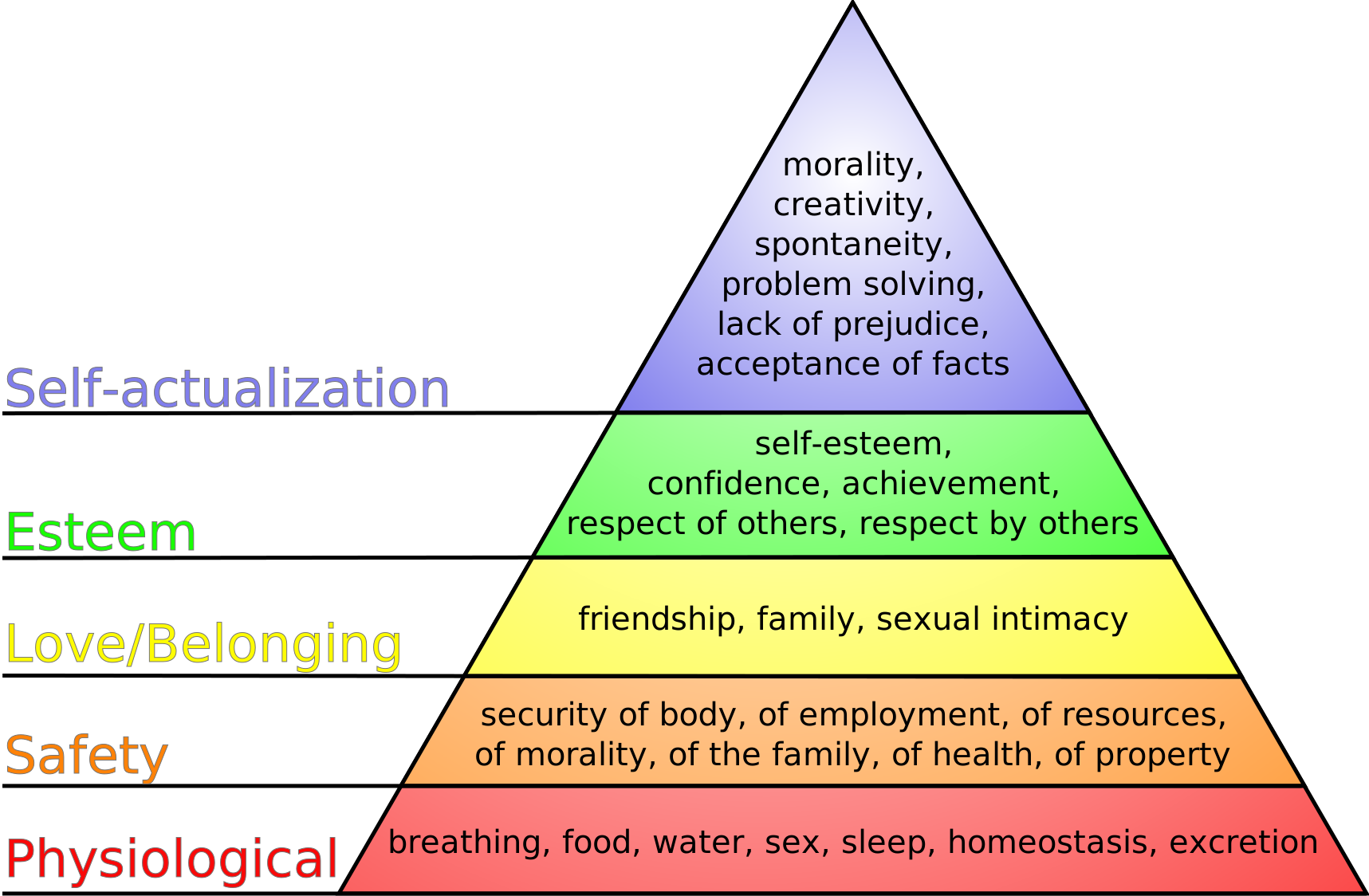 |
| Maslow's Hierarchy of Needs |
A caveat to my above statements: I am not saying that the lower needs are the same as the decadence associated with outward joy. They may be similar in purpose, but the intent is what matters. For instance, if you buy a multimillion dollar home, you are evoking your outward joy with perhaps no intention to focus on the inner joy. However, if you are not in shelter but buy your first home, you are meeting a basic need that will enable you to focus on the inner joy.
Now, I am going to take the opposite stance and pretend that Maslow’s hierarchy is completely untrue and biased because it only addresses Western culture and values. If this perspective is true, then all of Zambia has taught me that inner joy is independent of how much you have or what you have. Zambians are the happiest, friendliest, most joy-filled people ever - and their joy does not come from possessions. It comes from celebrating life and from trusting in God. Building houses in Kawama and interacting with Zambians helped to grow the fruit of joy within me by showing me where it truly comes from.
 |
| The faces of joy - which come from love, hope, and a strong community |
Only an experience in a developing nation and community, such as the ones that the Periclean program supports, could have helped an American such as myself to see that a viewpoint contradictory to Maslow could be viable on this earth. Sure, there is deep poverty in pockets of the United States, but for an entire country to be full of joy and hope in spite of hardship is beyond anything I have ever seen. It is an inspiration and a challenge to me, to let my joy come from within and to not be dependent on outer circumstance.
Regardless of your conclusion and perspective on how to attain true joy, spending time in Zambia through the Periclean Scholars program has taught me the essence of joy, a fruit I hope to cultivate well inside of me for a lifetime.
Thursday, August 4, 2011
Peace - Periclean Scholars & Fruits of the Spirit Series
Today’s post in the Periclean Scholars and fruits of the spirit series is on peace. Peace is the tranquility in the soul that is not affected by outside pressure. Those who express the fruit of peace have inner stability that allows orderly, stable conduct in chaotic, nerve-racking, or traumatic circumstances.
There was one experience during my time in Zambia where I felt a sense of urgency and pressure. We were laying bricks, mixing cement, digging out the latrine, and putting in backfill. I was tired, so I took a quick water break. When I sat down, I noticed a mother holding her child. The child had a softball-sized open gash in his thigh. He was not crying, and there was no traumatic event that anyone had witnessed. It seemed that his mother had brought him over in hopes that we could help. In any normal situation, the immediate response would be to grab the nearest first aid kit and administer cleaning solution and bandages. However, we had recently agreed in a community meeting to not give out items to individuals in the village if there were not enough for everyone. My inner compass told me to act. I asked the leader of Team Eagle, Tom, if I could go ahead and get the first aid kit to assist the child. He said go ahead, so I ran back to our quarters for a first aid kit. My fellow Periclean, Brandy, cleaned and bandaged the wound, and the child was as good as new.
One of the reasons why my soul was at peace during this crisis was because of the bigger picture. I had a firm understanding on why I had to do what I had to do. I knew that I had the skill and resources to act in the situation, if deemed appropriate. Most importantly, my soul was at peace because of our vision for the future. We would work to end this circumstance from happening again. This event, as well as many others, cemented our desire to return to Kawama and start a clinic. We were not powerless; we now had additional justification to take action.
Circumstances of upheaval and discomfort are those which test our inner peace. Performing work alongside the Zambian people meant that I would feel at least some discomfort, and I also knew that some upheaval could result from this. The Periclean program encourages peace of the spirit by helping us to realize the positive benefits of our service and the opportunity to remain connected with our partners. We are taught to believe that societies are different - and that one society is not better than another. Therefore, we come into a situation as foreigners with the understanding that there will be some discomfort, but there is no need to lose our inner peace and sense of well-being. Everything we did was a learning experience and had value in the long run - even those little moments of crisis.
Tranquility from within allowed the fruit of peace to be expressed on Zambian soil. The situation with the injured child could have been a chaotic situation that involved more people in the village, or I could have stressed out about it and upset the poor child or his mother. There was a good amount of pressure on me from different angles, but I remained calm and did what I had to do. In retrospect, it even gave us one more reason to build the clinic in Kawama. I am thankful that the Periclean program allowed me the opportunity to have an impact in a situation of potential chaos, enabling me to grow the fruit of peace.
There was one experience during my time in Zambia where I felt a sense of urgency and pressure. We were laying bricks, mixing cement, digging out the latrine, and putting in backfill. I was tired, so I took a quick water break. When I sat down, I noticed a mother holding her child. The child had a softball-sized open gash in his thigh. He was not crying, and there was no traumatic event that anyone had witnessed. It seemed that his mother had brought him over in hopes that we could help. In any normal situation, the immediate response would be to grab the nearest first aid kit and administer cleaning solution and bandages. However, we had recently agreed in a community meeting to not give out items to individuals in the village if there were not enough for everyone. My inner compass told me to act. I asked the leader of Team Eagle, Tom, if I could go ahead and get the first aid kit to assist the child. He said go ahead, so I ran back to our quarters for a first aid kit. My fellow Periclean, Brandy, cleaned and bandaged the wound, and the child was as good as new.
One of the reasons why my soul was at peace during this crisis was because of the bigger picture. I had a firm understanding on why I had to do what I had to do. I knew that I had the skill and resources to act in the situation, if deemed appropriate. Most importantly, my soul was at peace because of our vision for the future. We would work to end this circumstance from happening again. This event, as well as many others, cemented our desire to return to Kawama and start a clinic. We were not powerless; we now had additional justification to take action.
Circumstances of upheaval and discomfort are those which test our inner peace. Performing work alongside the Zambian people meant that I would feel at least some discomfort, and I also knew that some upheaval could result from this. The Periclean program encourages peace of the spirit by helping us to realize the positive benefits of our service and the opportunity to remain connected with our partners. We are taught to believe that societies are different - and that one society is not better than another. Therefore, we come into a situation as foreigners with the understanding that there will be some discomfort, but there is no need to lose our inner peace and sense of well-being. Everything we did was a learning experience and had value in the long run - even those little moments of crisis.
Tranquility from within allowed the fruit of peace to be expressed on Zambian soil. The situation with the injured child could have been a chaotic situation that involved more people in the village, or I could have stressed out about it and upset the poor child or his mother. There was a good amount of pressure on me from different angles, but I remained calm and did what I had to do. In retrospect, it even gave us one more reason to build the clinic in Kawama. I am thankful that the Periclean program allowed me the opportunity to have an impact in a situation of potential chaos, enabling me to grow the fruit of peace.
Wednesday, August 3, 2011
Goodness - Periclean Scholars & Fruits of the Spirit Series
Today's post in the Fruits of the Spirit series will address goodness. This fruit produced by the spirit exemplifies moral excellence, generosity, and strong virtue. By doing so, those who are full of the fruit of goodness use all of God’s creation for its rightful purpose.
Why were we put here on this earth? If only there were a simple answer to this question. The answer will vary for everyone, based on creed, upbringing, and overall values, but the collective answer should be in line with the concept of serving and benefiting others. I am a human being, just like everyone else here. My legacy should be woven in with the betterment of my fellow global citizens' lives, to as great a degree as possible.
The Periclean Scholars organization helped me to stop changing the channel on many of my fellow human beings that are in need of my assistance. Instead of ignoring the issues that are most pressing and most difficult to deal with, we were challenged to confront them and find the biggest challenge to tackle. Our purpose in developing and sustaining projects is to grow the fruit of goodness, in our classes and communities. With each new family that has the chance to live in a home in Zambia, with each new person in Namibia who is educated about the perils of HIV/AIDS, with each new clinic built, we are living out a deeper purpose.
As citizens of the developed world, we are equipped with many tools to carry out this work. They include our networks, our finances, the clothes off of our backs, the ability to write and petition, and more. I would argue that all of these powerful tools can be given in greater quantities to those in need thanks to our education. Therefore, the university setting - and the Periclean one, at that - is the perfect place to grow the fruit of goodness and purpose. We can choose to use these tools for good or for evil, for a strong purpose or for deep destruction.
Goodness is about inner purpose and intent. Our choices show how well our virtues are developed, if not the direction we yearn to take. For instance, an Elon student on a need-based scholarship may want to give back, but s/he cannot do so financially as readily as a student who grew up with a silver spoon in his/her mouth. For this student, opportunities such as the Periclean program enhance the ability to give back, as well as the ability to learn from the service. Though students in the developed world have more opportunities to give back, programs such as Periclean ensure that initial resources are not a hindrance.
Upon graduation from Elon, all alumni are equipped with the same diploma. I will argue, however, that they have different foundational educations and values based on how they chose to use their resources and grow their spirits. For those in the Periclean program, the diploma will be a powerful tool to do good deeds and to continue in generosity for the rest of their lives.
I am the first person to believe in free will, but I have to believe that there was a reason why I was born. There is a reason why my parents chose to have children and raise me as a citizen of the world. There is a reason beyond myself that I must give back. The spirit of goodness in me ensures that my time on earth is spent in pursuit of a positive purpose and legacy, not for myself and for my own pride, but for those who will come after me - around the world, and not just in my tiny community.
Goodness is more than just doing positive works. It is a deep sincerity in achieving our positive purpose. We were put here to serve others. I choose to use my free will and my time on this earth for that greater purpose, and the Periclean program has helped to grow that fruit in me.
Why were we put here on this earth? If only there were a simple answer to this question. The answer will vary for everyone, based on creed, upbringing, and overall values, but the collective answer should be in line with the concept of serving and benefiting others. I am a human being, just like everyone else here. My legacy should be woven in with the betterment of my fellow global citizens' lives, to as great a degree as possible.
The Periclean Scholars organization helped me to stop changing the channel on many of my fellow human beings that are in need of my assistance. Instead of ignoring the issues that are most pressing and most difficult to deal with, we were challenged to confront them and find the biggest challenge to tackle. Our purpose in developing and sustaining projects is to grow the fruit of goodness, in our classes and communities. With each new family that has the chance to live in a home in Zambia, with each new person in Namibia who is educated about the perils of HIV/AIDS, with each new clinic built, we are living out a deeper purpose.
As citizens of the developed world, we are equipped with many tools to carry out this work. They include our networks, our finances, the clothes off of our backs, the ability to write and petition, and more. I would argue that all of these powerful tools can be given in greater quantities to those in need thanks to our education. Therefore, the university setting - and the Periclean one, at that - is the perfect place to grow the fruit of goodness and purpose. We can choose to use these tools for good or for evil, for a strong purpose or for deep destruction.
Goodness is about inner purpose and intent. Our choices show how well our virtues are developed, if not the direction we yearn to take. For instance, an Elon student on a need-based scholarship may want to give back, but s/he cannot do so financially as readily as a student who grew up with a silver spoon in his/her mouth. For this student, opportunities such as the Periclean program enhance the ability to give back, as well as the ability to learn from the service. Though students in the developed world have more opportunities to give back, programs such as Periclean ensure that initial resources are not a hindrance.
Upon graduation from Elon, all alumni are equipped with the same diploma. I will argue, however, that they have different foundational educations and values based on how they chose to use their resources and grow their spirits. For those in the Periclean program, the diploma will be a powerful tool to do good deeds and to continue in generosity for the rest of their lives.
I am the first person to believe in free will, but I have to believe that there was a reason why I was born. There is a reason why my parents chose to have children and raise me as a citizen of the world. There is a reason beyond myself that I must give back. The spirit of goodness in me ensures that my time on earth is spent in pursuit of a positive purpose and legacy, not for myself and for my own pride, but for those who will come after me - around the world, and not just in my tiny community.
Goodness is more than just doing positive works. It is a deep sincerity in achieving our positive purpose. We were put here to serve others. I choose to use my free will and my time on this earth for that greater purpose, and the Periclean program has helped to grow that fruit in me.
Monday, August 1, 2011
Faithfulness - Periclean Scholars & Fruits of the Spirit Series
Today’s post in the Fruits of the Spirit series is faithfulness. Faithfulness is devotion; it is not wandering from commitments or promises, no matter how hard it gets. It is being someone that others can rely on.
The greatest tests of faithfulness are changes in time and location. When we first get energized by an opportunity to commit, it appears that remaining faithful will come easy. We promise to never forget a story, a face, or an experience and to live by what we learned from them from that moment forward. In that moment, remaining faithful is the path of least resistance. However, when time moves on and we go back to our normal location and routine, it becomes more and more difficult. Hence, faithfulness is a fruit that comes as a result of strong character and resolve. We remain faithful by choosing to carry our promises in our heart and fighting off temptation to break them.
My great test of faithfulness to the Kawama citizens and potential citizens came as soon as I left the village. While in the village, we put in as much time and effort to make as great of a difference as we can, because that is why we were there. They could rely on me to do the work at hand. When separated by time and distance, our group had a charge. We had to never forget the stories and people we met and to try our best to make sure that more have the opportunity at a better life. We promised to tell our friends and family about our experiences and to bring more awareness to the needs of the Zambian people. Our Elon professors, Tom and Steve, had promised to return and build more houses for the Zambian people. We all had the challenge to be faithful to that commitment through lapses in time and distance.
In the United States, the path of least resistance is to go with the flow, follow the crowd, and abide by WIIFM (“What’s In It For Me”). While many want to hear about Victoria Falls and the elephants on safari, not as many want to hear about the greatest needs of the Zambian people. Overcoming this resistance is hard, but doing so shows integrity to character. Whenever anyone asks me about my Zambia trip, I start out by describing the work we did with our partner, Habitat for Humanity-Zambia, through the Periclean Scholars group, and then I go into details about the safari and the falls.
Our faithfulness has proven fruitful. The Periclean Scholars, including leaders Tom and Steve, returned to Zambia to build more houses. We continue to tell friends and family about the Periclean journey. We constantly look for more ways to leave a positive influence on everyone with whom we have the opportunity to work. Our partners know they can count on our word. We rely on each other - and the strength of the PSAA reinforces our faithfulness.
I choose to remain faithful to the future homeowners in Kawama village and to help them attain the dream of their own homes through many outlets, such as this blog. My schedule in July (and continuing into August) continues to get busier, and my time is limited - but my commitment to the Periclean partners keeps me writing strong. I have also decided to remain faithful to those who participated in the Chitenge Challenge. I will honor those who have given, who are expecting me to wear a chitenge, by wearing one to work when I reach the $1,500 mark - whenever that may be.
The Periclean Scholars program has taught me to be more faithful to myself and to honor where I came from and the opportunity to give back. Faithfulness is a quality that transcends time and space when practiced to its truest. I will always remain faithful to the village of Kawama and to the Periclean partners, for helping to grow the fruit of faithfulness within me.
The greatest tests of faithfulness are changes in time and location. When we first get energized by an opportunity to commit, it appears that remaining faithful will come easy. We promise to never forget a story, a face, or an experience and to live by what we learned from them from that moment forward. In that moment, remaining faithful is the path of least resistance. However, when time moves on and we go back to our normal location and routine, it becomes more and more difficult. Hence, faithfulness is a fruit that comes as a result of strong character and resolve. We remain faithful by choosing to carry our promises in our heart and fighting off temptation to break them.
My great test of faithfulness to the Kawama citizens and potential citizens came as soon as I left the village. While in the village, we put in as much time and effort to make as great of a difference as we can, because that is why we were there. They could rely on me to do the work at hand. When separated by time and distance, our group had a charge. We had to never forget the stories and people we met and to try our best to make sure that more have the opportunity at a better life. We promised to tell our friends and family about our experiences and to bring more awareness to the needs of the Zambian people. Our Elon professors, Tom and Steve, had promised to return and build more houses for the Zambian people. We all had the challenge to be faithful to that commitment through lapses in time and distance.
In the United States, the path of least resistance is to go with the flow, follow the crowd, and abide by WIIFM (“What’s In It For Me”). While many want to hear about Victoria Falls and the elephants on safari, not as many want to hear about the greatest needs of the Zambian people. Overcoming this resistance is hard, but doing so shows integrity to character. Whenever anyone asks me about my Zambia trip, I start out by describing the work we did with our partner, Habitat for Humanity-Zambia, through the Periclean Scholars group, and then I go into details about the safari and the falls.
Our faithfulness has proven fruitful. The Periclean Scholars, including leaders Tom and Steve, returned to Zambia to build more houses. We continue to tell friends and family about the Periclean journey. We constantly look for more ways to leave a positive influence on everyone with whom we have the opportunity to work. Our partners know they can count on our word. We rely on each other - and the strength of the PSAA reinforces our faithfulness.
I choose to remain faithful to the future homeowners in Kawama village and to help them attain the dream of their own homes through many outlets, such as this blog. My schedule in July (and continuing into August) continues to get busier, and my time is limited - but my commitment to the Periclean partners keeps me writing strong. I have also decided to remain faithful to those who participated in the Chitenge Challenge. I will honor those who have given, who are expecting me to wear a chitenge, by wearing one to work when I reach the $1,500 mark - whenever that may be.
The Periclean Scholars program has taught me to be more faithful to myself and to honor where I came from and the opportunity to give back. Faithfulness is a quality that transcends time and space when practiced to its truest. I will always remain faithful to the village of Kawama and to the Periclean partners, for helping to grow the fruit of faithfulness within me.
Friday, July 29, 2011
Kindness - Periclean Scholars & Fruits of the Spirit Series
In continuing with the fruits of the spirit series, today’s topic will be kindness and how the Periclean program helped to make this fruit bountiful in the program’s participants.
Kindness can be summarized as acting for the good of others regardless of what they do. An act of kindness, or the action that you show toward those who test your patience, could be considered a fruit of a fruit (the offspring of patience). The expression of this fruit comes to mind as with those who have power (or the illusion of power) over another, such as a kind and benevolent king. It may seem that their treatment of those beneath them does not matter, but kind people will act in the best interest of those they dominate (or appear to dominate). Kindness does not refer to being a nice person. In fact, sometimes it can be the opposite, if you act in someone else’s best interest but what they ask for is the opposite of what you give.
For people who spent a lot of time and money to build in Zambia, the urge to give, give, give remains heavy while on the ground. This includes the urge to give of our possessions, as we saw how little each family had compared to the opulence of America. Plus, it wouldn’t hurt to lighten our load of some items from our suitcases before returning to America. We were certainly in a position of instant power, to create positive change - or to create chaos.
On one of the first days in the village, we attended a meeting with the village adults and elders. This meeting set the ground work for our stay in Kawama and what was expected of both groups. During a prior build with volunteers from Ireland, some of the volunteers had given donations, such as mattresses, to specific families in the village. Of course, during the meeting those who had received the gifts spoke out in favor of wanting to receive more gifts, from a new group of Westerners that had arrived. Yet, the village leaders had the wisdom to know that the cycle of jealousy and argument would begin anew if we had given gifts to only a few people. Therefore, at this meeting it was decided that no gifts would be asked for by the villagers and that no gifts would be given by the volunteers.
After this meeting, we spoke with our team leaders and our Habitat coordinators. We still wanted to give and had items to give, but we wanted to act out of kindness and not chaos or pride. Therefore, it was decided that donation would be given to HFHZ’s headquarters in Lusaka, and the staff would distribute the items based on greatest needs. This limited the amount of pride that was invested into the donations themselves. Our goal at the build was to learn from the villagers and construct houses, not to determine our favorite families to bestow with blankets and t-shirts.
Kindness comes in many different packages. My experience in Zambia showed me that acting in the best interest of others may seem counterintuitive at times, but listening to the wisdom of the leaders kept our moral and spiritual compasses in check. We had to show patience by not giving immediately, but by holding off and letting donations be distributed by those who know the village best.
I am thankful to the Periclean program for allowing the fruit of kindness to grow within me, in a way that may not seem apparent to most at first.
Kindness can be summarized as acting for the good of others regardless of what they do. An act of kindness, or the action that you show toward those who test your patience, could be considered a fruit of a fruit (the offspring of patience). The expression of this fruit comes to mind as with those who have power (or the illusion of power) over another, such as a kind and benevolent king. It may seem that their treatment of those beneath them does not matter, but kind people will act in the best interest of those they dominate (or appear to dominate). Kindness does not refer to being a nice person. In fact, sometimes it can be the opposite, if you act in someone else’s best interest but what they ask for is the opposite of what you give.
For people who spent a lot of time and money to build in Zambia, the urge to give, give, give remains heavy while on the ground. This includes the urge to give of our possessions, as we saw how little each family had compared to the opulence of America. Plus, it wouldn’t hurt to lighten our load of some items from our suitcases before returning to America. We were certainly in a position of instant power, to create positive change - or to create chaos.
On one of the first days in the village, we attended a meeting with the village adults and elders. This meeting set the ground work for our stay in Kawama and what was expected of both groups. During a prior build with volunteers from Ireland, some of the volunteers had given donations, such as mattresses, to specific families in the village. Of course, during the meeting those who had received the gifts spoke out in favor of wanting to receive more gifts, from a new group of Westerners that had arrived. Yet, the village leaders had the wisdom to know that the cycle of jealousy and argument would begin anew if we had given gifts to only a few people. Therefore, at this meeting it was decided that no gifts would be asked for by the villagers and that no gifts would be given by the volunteers.
 |
| The tent where the village held meetings. |
 |
| Even though we couldn't give tangibles, we could still give hugs! |
I am thankful to the Periclean program for allowing the fruit of kindness to grow within me, in a way that may not seem apparent to most at first.
Thursday, July 28, 2011
Patience - Periclean Scholars & Fruits of the Spirit Series
Today I am starting a new post series on the fruits of the spirit. For those who may not be familiar with the concept, the fruits of the spirit are a list of characteristics that are attributed to a Christ-like life. They arise from changes in character toward a positive, loving, benevolent nature. Like plants that have been given fertile, nutritious soil and produce wholesome, delicious fruit, the nutrients of an enriched character and purpose (and for Christians, faith in Christ) create fruits of the spirit. Those who produce bountiful fruit provide much benefit to the community.
The fruits of the spirit come from Galatians 5:22-23: "But the fruit of the Spirit is love, joy, peace, forbearance, kindness, goodness, faithfulness, gentleness and self-control. Against such things there is no law."
Please note that this series is not to be considered a sermon; I am not a preacher. I am also not saying that the Periclean program supplants religious and spiritual devotion - far from it. Rather, I believe that Periclean Scholars helps students to live out their commitments to their faith and to grow as people. I will illustrate the growth of each fruit through the Periclean program with a narrative or two.
I will address each fruit in popcorn format - i.e., as I wish and not in any sort of predetermined order.
Today's fruit is patience. It is mentioned in the Bible as being calm and reducing the temper. Because of Murphy's Law, patience is a virtue that we often have the time and ability to practice, yet do not always do so willingly.
On much of the African continent, the acronym "T.I.A." is used liberally. It stands for "This is Africa", and it is a phrase that helps Westerners to adjust to the fact that many practices will require patience. One should go into any situation with an open mind, a sense of calmness, and a small temper to achieve maximum success and minimal blood pressure. By making the journey to many parts of Africa, we allow ourselves the opportunity for either our patience or our blood pressure to grow. I chose patience.

Today's anecdote comes from our very first day in Kawama village. We had made the seven hour trek from Lusaka to Kawama, right outside of Ndola. When we arrived, it was dark and pouring rain. When we woke up the next morning, we found that the bus that had brought us to Kawama was stuck in the mud.
This was a T.I.A. moment and a decision point. Would we begin work on the new houses, or would we wait for the bus to move before commencing work? The answer: neither. We didn't start work, but we didn't wait around.
The Periclean Scholars and the Kawama residents - including children - helped to create dry patches for the bus' wheels to rise up and drive from out of the mud. We carried bricks from the construction brick pile and threw them under the bus to the wettest spots underneath the tires. This required precious time and resources. First, we were only in Kawama for a fixed period of time, and we had to use as many dry, daylight hours as possible to maximize construction on the two new homes for Lontia and Rosemary. Second, the resource of sun-dried brick is incredibly valuable to the community, so to use them for a purpose other than to build homes is a true sacrifice.
Patience is most needed in a crisis, such as the one suffered by the bus driver. By delaying construction of the homes and choosing instead to use valuable time and resources, we made the decision to show mercy toward the hardship of another, one of our fellow global citizens.
Some would say that this would be an opportunity to show others the fruit of patience, that we should have just let the bus driver create his own dry patches and started on building the homes. However, through this experience I would have to strongly disagree. Patience is not a fruit that we are meant to require of one another, unlike other fruits like love. Patience is a fruit that comes from circumstance or God's will; like death, it is a bitter fruit to swallow that is not ours to determine. By enduring it and minimizing its burden in others, we grow spiritually and as a community.
Because of the spirit of patience evident in all who chose to help, it took a lot less time to get the bus moving than it would have had we looked the other way. Because of the bus that was stuck, we had our first opportunity to bond and work together with all of the Kawama community.
I am thankful to the Periclean program for giving me many opportunities to grow the fruit of patience, including the one listed in this narrative.
The fruits of the spirit come from Galatians 5:22-23: "But the fruit of the Spirit is love, joy, peace, forbearance, kindness, goodness, faithfulness, gentleness and self-control. Against such things there is no law."
Please note that this series is not to be considered a sermon; I am not a preacher. I am also not saying that the Periclean program supplants religious and spiritual devotion - far from it. Rather, I believe that Periclean Scholars helps students to live out their commitments to their faith and to grow as people. I will illustrate the growth of each fruit through the Periclean program with a narrative or two.
I will address each fruit in popcorn format - i.e., as I wish and not in any sort of predetermined order.
Today's fruit is patience. It is mentioned in the Bible as being calm and reducing the temper. Because of Murphy's Law, patience is a virtue that we often have the time and ability to practice, yet do not always do so willingly.
On much of the African continent, the acronym "T.I.A." is used liberally. It stands for "This is Africa", and it is a phrase that helps Westerners to adjust to the fact that many practices will require patience. One should go into any situation with an open mind, a sense of calmness, and a small temper to achieve maximum success and minimal blood pressure. By making the journey to many parts of Africa, we allow ourselves the opportunity for either our patience or our blood pressure to grow. I chose patience.

Today's anecdote comes from our very first day in Kawama village. We had made the seven hour trek from Lusaka to Kawama, right outside of Ndola. When we arrived, it was dark and pouring rain. When we woke up the next morning, we found that the bus that had brought us to Kawama was stuck in the mud.
This was a T.I.A. moment and a decision point. Would we begin work on the new houses, or would we wait for the bus to move before commencing work? The answer: neither. We didn't start work, but we didn't wait around.
 |
| Neither did the entire village |
Patience is most needed in a crisis, such as the one suffered by the bus driver. By delaying construction of the homes and choosing instead to use valuable time and resources, we made the decision to show mercy toward the hardship of another, one of our fellow global citizens.
Some would say that this would be an opportunity to show others the fruit of patience, that we should have just let the bus driver create his own dry patches and started on building the homes. However, through this experience I would have to strongly disagree. Patience is not a fruit that we are meant to require of one another, unlike other fruits like love. Patience is a fruit that comes from circumstance or God's will; like death, it is a bitter fruit to swallow that is not ours to determine. By enduring it and minimizing its burden in others, we grow spiritually and as a community.
Because of the spirit of patience evident in all who chose to help, it took a lot less time to get the bus moving than it would have had we looked the other way. Because of the bus that was stuck, we had our first opportunity to bond and work together with all of the Kawama community.
I am thankful to the Periclean program for giving me many opportunities to grow the fruit of patience, including the one listed in this narrative.
Subscribe to:
Posts (Atom)